What do event people fear most?
Not an umbrella that costs 0.2 USD more.
It is the event that has already started — and the umbrellas are still on the road.
For trade shows, brand pop-ups, golf tournaments, product launches, sponsorship activations, film premieres and corporate celebrations, a lot can be adjusted at the last minute:
- the design can be simplified;
- the colours can be reduced;
- the packaging can be swapped;
- the quantity can be re-split;
- shipping can switch from sea to air.
But the event date usually cannot move.
So the most important buying logic for a custom event umbrella is not:
“What kind of umbrella do we want to make?”
It is:
“By what date must these umbrellas actually be in hand?”
This article is written for event agencies, exhibition / trade show organizers, sponsorship teams, brand activation agencies, corporate event buyers, golf event organizers and festival / outdoor event teams.
If your project has a fixed, immovable date, everything below — logo, proof, sample, production, packing, shipping — should be counted backwards from that date.
If you just want the MOQ, printing and quoting basics for ordinary promotional umbrellas, see our promotional umbrella wholesale and customization guide.
First Fix the Four Dates, Not the Umbrella
In an event order, the “date” is itself a specification. There are four dates that really matter.
1. Event Date
This is the date the umbrellas are actually used, handed out or displayed. For example: a trade show on November 15; a golf tournament on May 20; a product launch on September 3; a film premiere; an anniversary; an outdoor festival.
2. Required In-hands Date
This date matters more than the event date. Do not let the goods arrive on the morning of the event. We usually recommend leaving the event team time to count, split by venue, split VIP / staff / guest, check the packaging, place into media kits and deliver to the booth or warehouse.
So what you should actually tell the manufacturer is:
“The umbrellas must arrive by November 12.”
Not:
“Our event is November 15.”
3. Ship Date
The in-hands date minus transit time gives the latest shipping window. Common reference times today:
| Shipping method | Reference time |
|---|---|
| Express DHL / UPS / FedEx | 3–7 days |
| Air freight | 7–12 days |
| Sea freight | 25–35 days |
Actual times still need to be confirmed by country, city, customs and the logistics situation at the time.
4. Order / Artwork Lock Date
This is the date most easily overlooked. Production does not start from your first email. The real starting point is usually: specification confirmed; artwork confirmed; sample approved; deposit / order confirmed.
So the event team should count backwards:
Event Date → In-hands Date → Shipping Window → Bulk Production → Sample / Proof Approval → Artwork Deadline
If the artwork deadline you calculate has already passed, stop pretending this is a “normal order.” You have now entered a rush + scope reduction decision.
How Far in Advance Does an Event Order Really Need?
Our common reference times today:
| Stage | Reference time |
|---|---|
| Pre-production sample | 7–10 days |
| Bulk production | 15–25 days, depending on quantity and complexity |
| Express | 3–7 days |
| Air freight | 7–12 days |
| Sea freight | 25–35 days |
Note: these times do not mechanically add up to a “guaranteed deadline.” There may also be artwork revisions, late sponsor logos, internal client approvals, sample rework, weekends, holidays, customs clearance and on-site re-splitting. So a real event team should leave buffer.
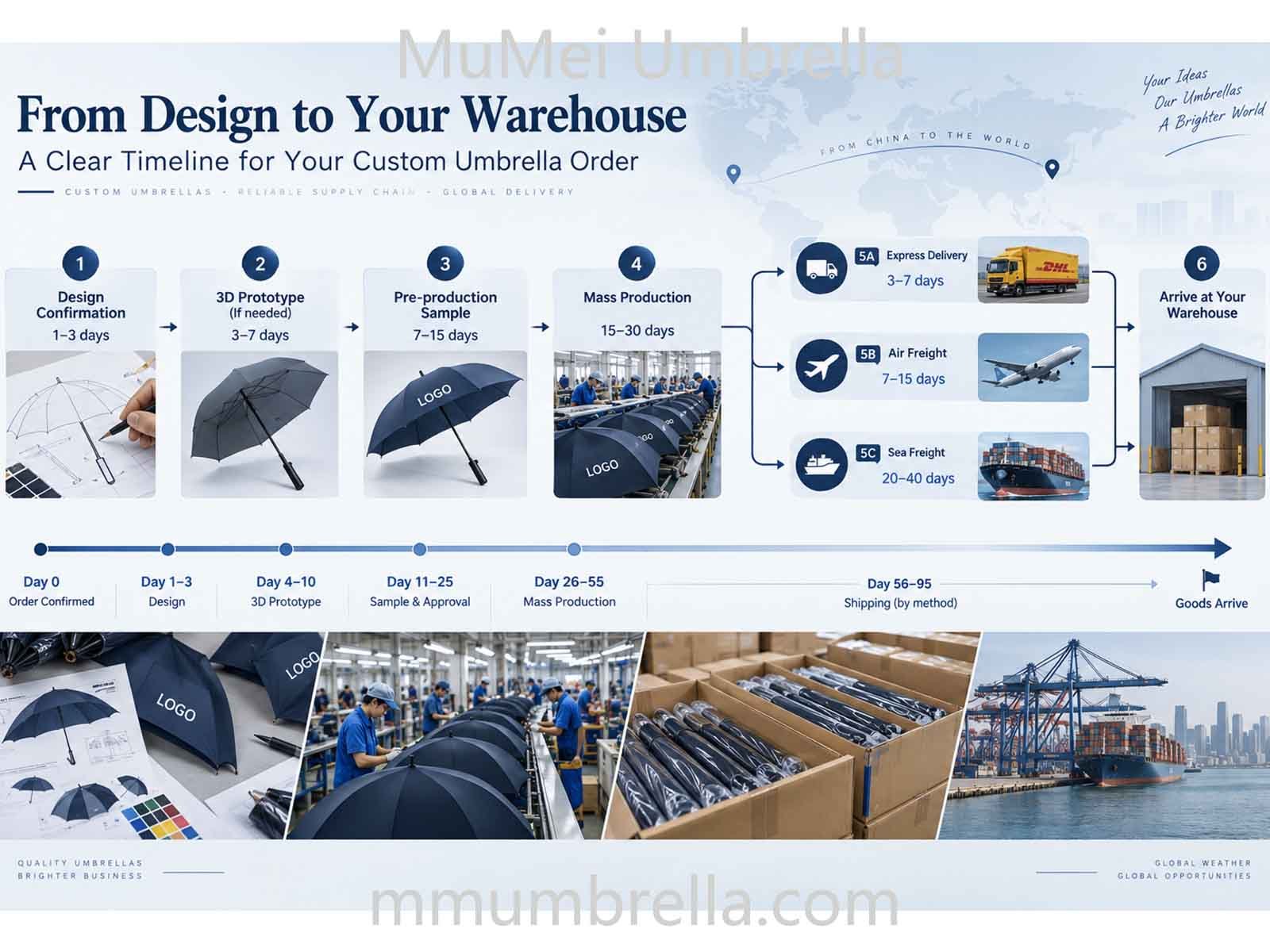
A simple example
Suppose: event date is the 10th; everything must arrive before the 9th; you use express; bulk production runs about 15–25 days; and a pre-production sample is still needed. Then you cannot formally confirm the order on the 1st of the month. Production may need to start in the first half of the previous month, and the sample even earlier.
That is why “Can you rush this?” is not a specific enough question. More useful is:
“Our event is on November 15. We need 800 umbrellas in Madrid by November 11. Artwork can be locked today. What is the safest production and shipping plan?”
That is the information a factory can actually judge a project on.
Where Event Orders Slip: Sponsor Logos Keep Changing
One of the biggest differences between an event project and an ordinary corporate gift is this: the sponsor list may keep changing until the last minute. That is dangerous for umbrella production, because each new logo can affect the layout, logo size, print position, Pantone, printing plates, proof, sample and production time.
So a large sponsorship event should set an early Artwork Freeze Date. For example: “No new sponsor logos after September 1.” Not because the factory is unwilling to cooperate, but because without an artwork lock there is no real production starting point.
Multiple Sponsor Logos: Decide the Sponsor Hierarchy First
One event may include an organizer, a title sponsor, gold sponsors, supporting partners, a venue and a media partner at the same time. If you just cram every logo into one canopy, the result is often that nothing is legible. Two approaches usually work better.
Option A: All sponsors share one visual area
Fits: a small number of logos; similar sponsor levels; a preference for simple production; one design for all umbrellas. The advantage is one artwork, simple production.
Option B: Split by sponsor level
For example: title sponsor gets a larger logo; organizer gets a fixed main position; secondary sponsors go on other panels; the VIP version uses one colour; the staff version uses another. This gives a clearer visual hierarchy, but adds artwork files, SKUs, print positions and quoting complexity.
So before sending logos to the factory, the event team should decide internally: who is biggest, who must share a panel, and who can be shrunk. Do not let the manufacturer decide sponsor politics for you.
How to Print the Event Logo — Don’t Just Tell the Factory “Silk Screen It”
What actually decides the method is the artwork. Event designs fall into roughly three groups.
1. Simple sponsor logos
White logos, black logos, 1–4 solid colours, no photos, no complex gradients. These can usually evaluate screen printing first.
2. Multi-colour, gradient or photo artwork
Colour sponsor logos, gradients, images and complex visuals can evaluate heat transfer and other full-colour options.
3. The whole umbrella is the event visual
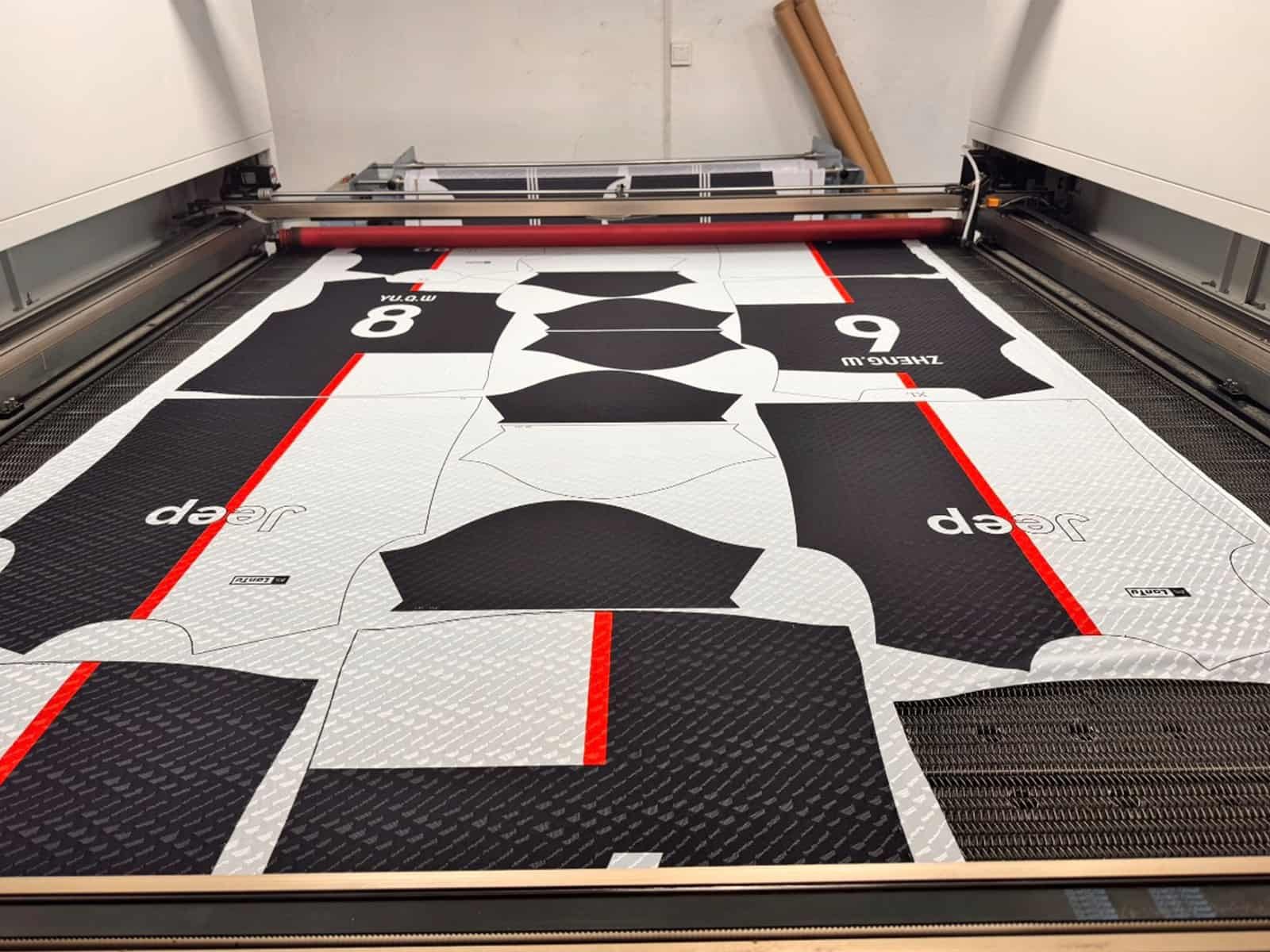
Some projects are not “add a logo to the umbrella” but “the umbrella is part of the event visual” — a festival pattern, a brand activation, a large campaign graphic, a full colour block, or several panels forming one complete image. These projects are better discussed separately for full-print and dye sublimation options.
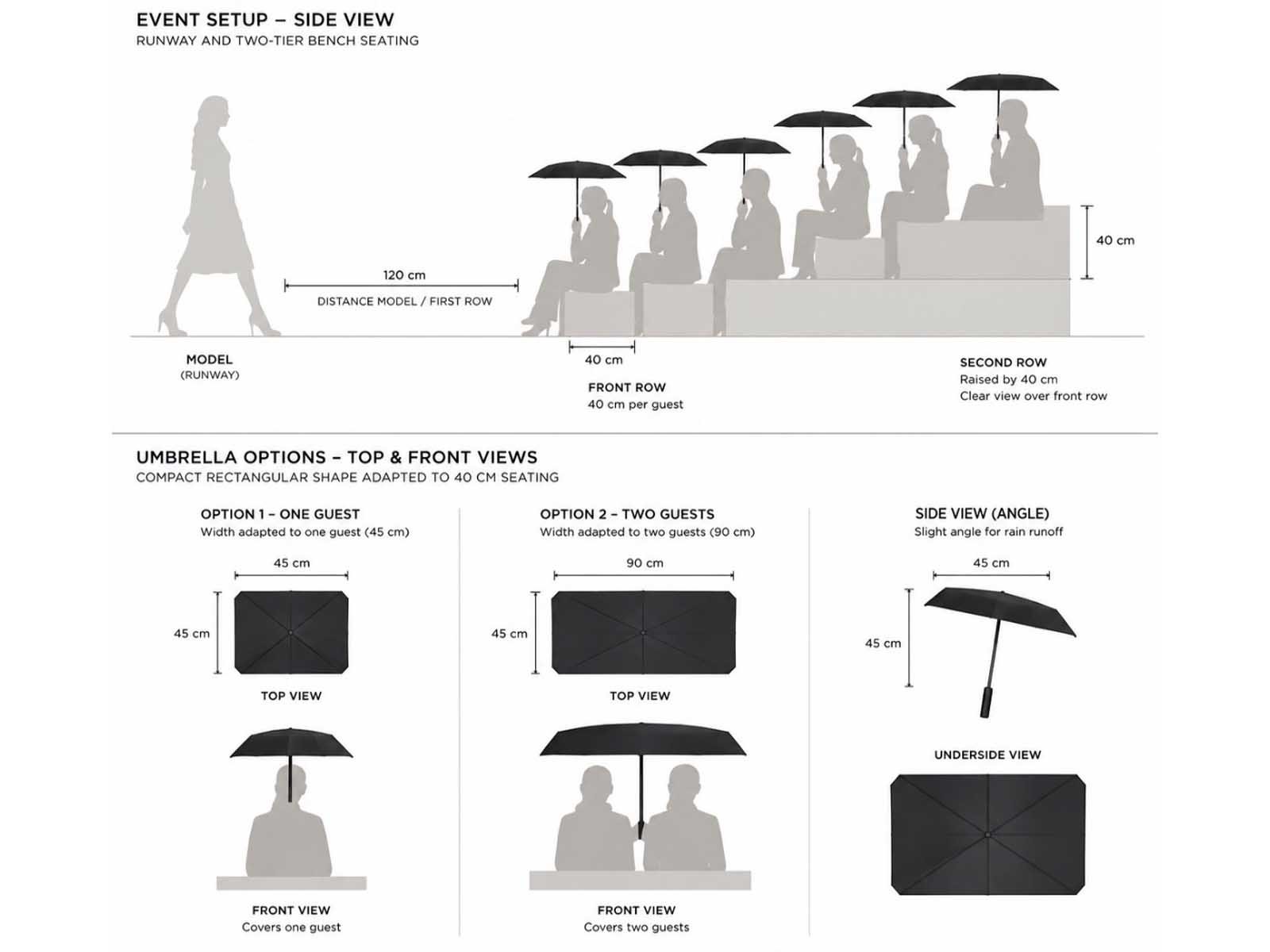
Sometimes the event visual is not only about printing — the structure itself changes. We once developed a special square rain-shade structure for a French outdoor stage production in Paris: a single-person cover, on a very tight deadline. It looked a little like a car windscreen sun shade, but the use was completely different. This kind of requirement cannot be fitted into an ordinary catalogue — it has to be rebuilt from use case → required coverage → structure → sampling.
For the detailed differences between the four umbrella printing methods, we have a separate complete umbrella printing methods comparison, so this article does not repeat every printing technique.
One, Two or Eight Panels — On-Site Visibility Differs a Lot
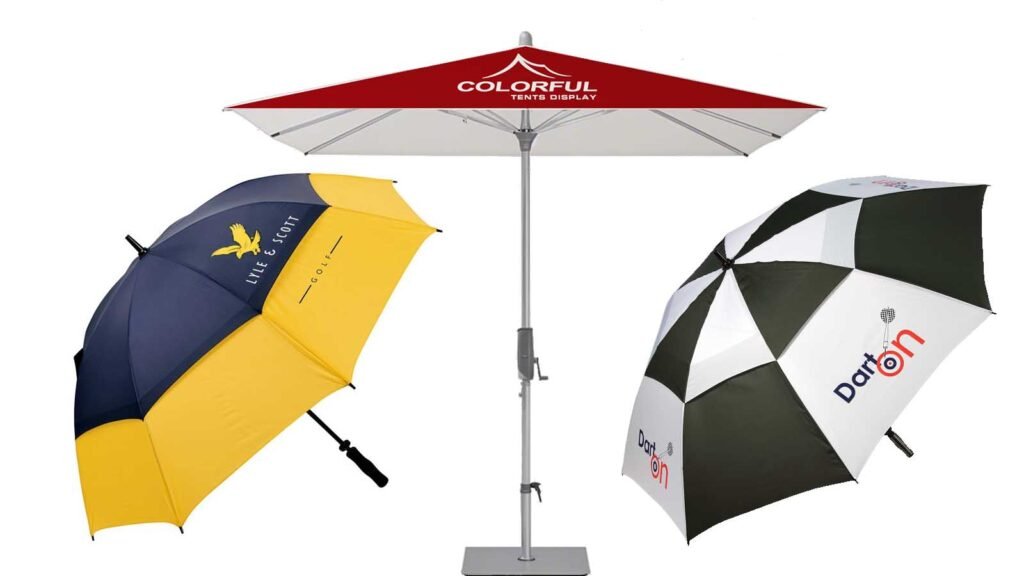
An often-underestimated question in event projects is: from which angle should the logo actually be seen? If the umbrella is just a guest gift, one or two panels may be enough. But if the umbrella also carries sponsor exposure, outdoor crowd visuals, photo backdrops, golf-event branding or staff identification, the logo position should be considered against how it is used on site.
For example:
Golf event
The canopy is large, so the title sponsor can stay visible from a distance.
Trade show giveaway
A folding umbrella is more practical, but the logo does not need to cover the whole canopy.
Outdoor festival
When many participants open umbrellas at once, colour blocks and the overall visual may matter more than a very small logo.
In short: a sponsor mark must not shrink until it disappears in the crowd and in the photos — an event umbrella is both rain protection and a visual asset.
Digital Proof vs Physical Sample: The Tighter the Deadline, the More They Matter
Event clients often say: “The schedule is this tight — do we still need a sample?” First separate two things.
Digital Proof / Artwork Approval
It confirms the logo, the panel, the position, the size, the Pantone and the sponsor arrangement. This should be approved as quickly as possible — many promotional platforms treat artwork approval as the formal start of production.
Pre-production Sample
A physical sample also lets you check the real colour, the print effect, the canopy fabric, the handle, the opening, the packing and the overall proportion. For strict brand colours, large-area visuals, VIP gifts and complex sponsor layouts, the physical sample is very valuable.
What to cut when time is tight
I would rather cut first: the number of colours, the print positions, the special packaging, new structure development and unnecessary accessories — not the artwork approval. The one day saved by skipping the proof can mean the entire bulk run printed wrong.
Rush Orders: What Actually Saves Time Is Limited
The most dangerous sentence in an event order is:
“Money is not a problem, just make it faster.”
Money can solve part of the problem, but it cannot turn a physical production process that already needs 20 days into 2 days. What actually shortens the schedule is usually:
1. Use a proven, existing umbrella model
Do not suddenly develop a new handle, a new frame or a new mould a month before the event. If the event date is absolutely fixed, prefer a proven structure.
2. Hand in the artwork complete in one go
Do not send the organizer logo today, sponsor A in two days and sponsor B two days after that.
3. Set a single final approver
The real risk is not a revision. It is “marketing says yes, the sponsor says no, and the boss changes it again the next day.” Fix a Final Artwork Approver early and give that person’s contact directly to the supplier.
4. Reduce the print scope
Going from “print all eight panels” to “two main logo panels” is sometimes more realistic than squeezing the production window.
5. Switch the shipping method
Sea → air, or air → express. Much of a “rush” really compresses logistics, not production.
In short: event buyers are not buying “eventually in stock” — they are buying “in hand before that date.”
Multi-Venue, Multi-City Projects: Addresses Are Part of the Spec
The event industry rarely has a single delivery address. A project may be: London venue 300 pcs; Paris venue 200 pcs; Madrid venue 300 pcs; hotel / VIP reception 100 pcs.
Do not turn those 900 pieces into “ship 900 pcs to Europe.” Before production, give the factory a table like this:
| Destination | Qty | Carton mark | Required date |
|---|---|---|---|
| Venue A | 300 | EVENT-A | Nov 10 |
| Venue B | 200 | EVENT-B | Nov 12 |
| Hotel | 100 | VIP | Nov 11 |
Multi-location delivery affects carton splitting, marks, the packing list, the shipping arrangement and the final logistics cost. Changing addresses after packing is finished is very painful.
Why Event Umbrella Packing Is Not Just About Looks
What the on-site team really cares about is: can the staff hand them out quickly?
Individual bag packing
Fits trade shows, ordinary giveaways and piece-by-piece distribution by staff.
Bulk cartons by quantity
Fits backstage warehouses, on-site bulk handling and large-scale ordinary handouts.
VIP / media kit
If the umbrella is only part of a gift set, a more complete custom packaging can be made.
Cartons marked per venue
This is one of the least visually impressive but most useful customizations on site. For example: VIP — 50 PCS; STAFF — 80 PCS. It will not make the Instagram photo better, but it will save many people crouching on the warehouse floor opening boxes to find things on event day.
Event Umbrella Quantities: Don’t Just Count Attendance
A trade show expecting 1,000 people does not mean you must buy 1,000 umbrellas. First ask: are the umbrellas for everyone, for VIPs, for qualified leads only, for staff use, for sponsor gifts or for on-site sale? Then calculate the quantity. Also consider staff, last-minute guests, sponsors, media, loss and a final-day top-up.
The real event purchase quantity is Distribution Plan → Qty, not Attendance → Qty.
If the Event Runs Every Year, Year Two Should Be Easier
What an annual event should keep is not just the supplier’s contact. Keep the Pantone, the logo files, the final artwork, the print size, the panel position, the approved sample, the packaging, the carton mark, the SKU and the final quantity. Then year two only needs to update the date, the sponsors and the quantity — instead of asking again “roughly how big was last year’s logo?”
Our currently published manufacturing-defect warranty is 1 year; specific orders are still subject to final confirmed terms.
Before Releasing an Event Order, Check These 10 Items
- Event date;
- Required in-hands date;
- Total quantity + staff / VIP / buffer;
- Umbrella type and size;
- Final sponsor list;
- Vector logos + Pantone;
- Panel, size and position for each logo;
- Final artwork approver;
- Quantity per venue / address;
- Shipping method + latest ship date.
If items 5, 7 and 8 are still undecided, do not pretend the artwork is already locked.
Frequently Asked Questions
How far in advance should custom event umbrellas be ordered?
Count backwards from the required in-hands date. Current reference: pre-production sample 7–10 days; bulk 15–25 days; express 3–7 days; air 7–12 days; sea 25–35 days. Also leave buffer for artwork revisions, approvals, customs and on-site preparation.
Can you take a rush order for a fixed event date?
It can be evaluated first, but not every project suits a rush. Provide: Event Date + Destination + Quantity + Artwork Status. We will judge whether a normal plan still works, or whether the specification must be simplified or shipping upgraded.
If time is tight, is a digital proof still needed?
Yes. The tighter the schedule, the more the pre-production artwork approval matters. Skipping the proof may save a little time, but if it prints wrong there is usually no re-run window left.
If time is tight, is a physical sample still needed?
Judge by project risk. A simple logo project can use the digital proof as the core approval file. If brand colour, a complex sponsor layout, large-area printing or a VIP project is involved, a physical pre-production sample is more valuable.
Can one umbrella print multiple sponsor logos?
Yes. Multiple logos can share one artwork, use different sizes by sponsor level, different panels, or different colours / SKUs. The more logos and print positions, the more complex the artwork and quoting structure.
How should a full event pattern be handled?
Complex full-colour, gradient, cross-panel or large-area designs need heat transfer or dye sublimation options evaluated against the artwork and fabric. See our umbrella printing methods comparison.
Can you deliver directly to the venue or hotel?
It can be discussed per order. Provide early: address, contact, phone, required date and quantity. For multiple locations, provide the complete destination list before production.
How many umbrellas should a trade show order?
It depends on the distribution logic, not just attendance. First decide whether they are mass giveaway, VIP gift, qualified-lead gift, staff equipment or sponsor gift, then add a sensible buffer.
Can the same design be repeated next year?
Yes, by keeping the Pantone, artwork, print position, approved sample, packaging and SKU to improve replenishment consistency.
Have a Date You Cannot Miss?
If your date is already fixed, do not spend the first week discussing umbrella styles. Send these five items first:
Event Date + Required In-hands Date + Quantity + Destination + Current Artwork
If the sponsor list is not final yet, say so directly. We can first judge whether normal production still fits, whether express, air or another plan is needed, which customizations can be kept and which should be simplified — then move into a formal quote.
Browse the promotional umbrella guide · Browse umbrella printing methods