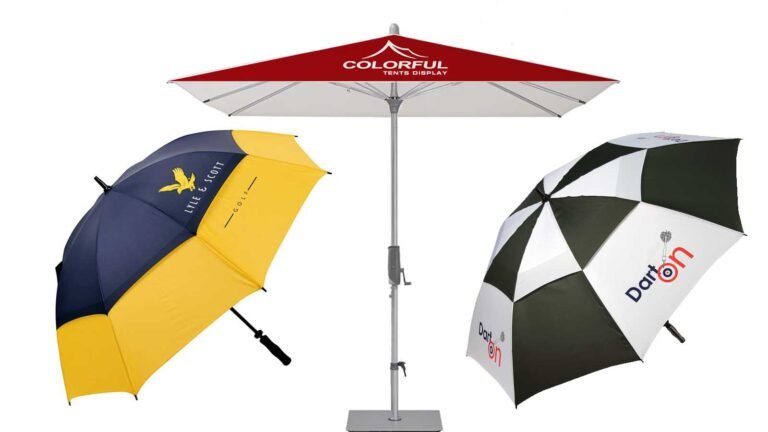
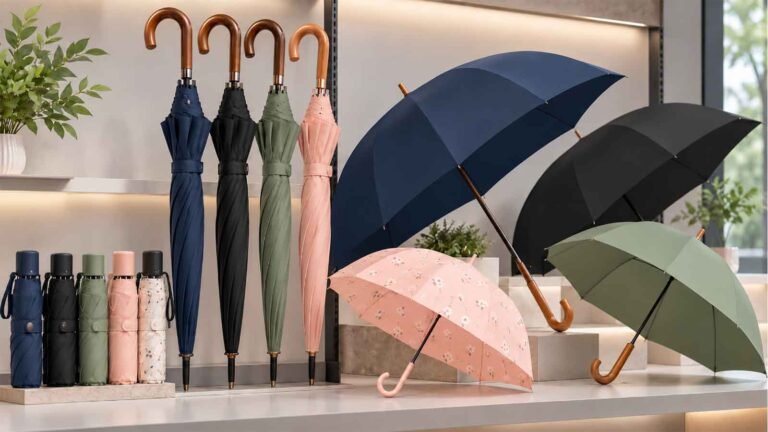
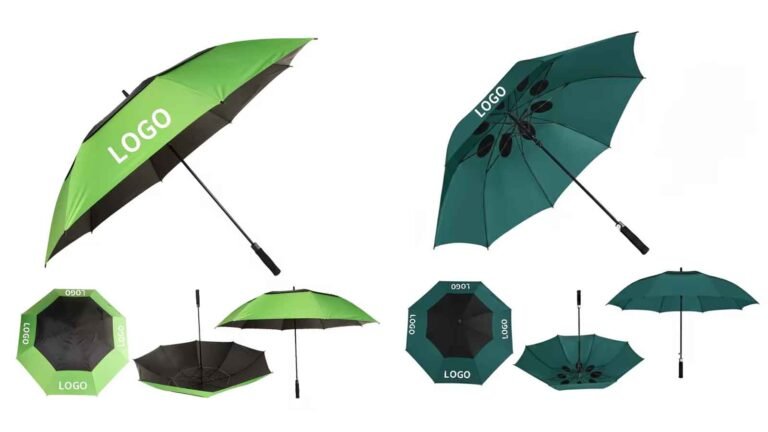
Printing a logo on a stock umbrella is, most of the time, a purchase.
But if you are preparing to add umbrellas to your own product line and sell them long-term through your website, stores, Amazon, Shopify or other retail channels, it is no longer as simple as “find an umbrella and print a logo.”
What you are really doing is product development:
- who is this umbrella for;
- what is the target retail price;
- how many colours will the first order have;
- use an existing frame or develop a new structure;
- should the handle, tip, sleeve and packaging look like your own brand;
- how many rounds will the sample need;
- can the launch date be met;
- and can the second reorder produce the same product again.
That is why I prefer to treat a private label umbrella as a product project, not a promotional item.
If you already have a product concept, mood board, competitor reference or tech pack, you can move straight into development. If you only have an idea right now, you can also start from the target customer, target price and sales channel.
If you already know you want a manufacturer to move the project forward, you can also start with our private label umbrella OEM/ODM development page.
First, Separate the Three Routes: Print-Only, OEM or ODM?
This is the most important step in the whole project.
Many brands call three completely different needs “custom umbrella” on their first call with a factory. But each needs a very different level of development investment.
Route 1: Existing model + brand printing
This is the simplest form of private label.
You pick a combination from the factory’s existing umbrella types, frames, handles, fabrics and colours, then add your own logo, hang tag or packaging.
The advantages are fast development, low risk, no need to redesign a structure, and a good fit for testing a new product line.
Our usual minimum for canopy customization is:
200 pieces per colour, per design.
Outdoor umbrellas usually start from 100 pieces.
If you just want to validate “will my customers buy a branded umbrella,” this is usually the most sensible first step.
Route 2: OEM — produced to your specification
OEM is closer to real product development.
You are no longer only choosing a logo; you start specifying the canopy fabric, frame, opening method, handle, tip, colour, printing, sleeve, packaging, labels and barcodes.
The manufacturer samples and produces to the specification you confirm.
At this point the umbrella is no longer “a standard umbrella with a brand on it” — it exists as your SKU.
Route 3: ODM / structural development — the product itself is rebuilt
If your brand concept includes a special-shaped handle, an unusual tip or cap, a new opening mechanism, a special frame size or a structure that does not exist in the current market, the project moves into deeper ODM development.
The biggest difference here is:
you are not choosing parts from a menu — you are developing new parts together.
For a first collection, 3D printing helps a lot. Some special handles, tips and caps can be validated for shape and assembly through 3D printing first, without committing to injection moulding right away.
Once sales stabilize and volume rises, you can then evaluate moulding for mass production, where the unit cost is usually more reasonable.
For structure, 3D printing, wood and metal options on special handles, see our custom umbrella handle development guide.
Six Things to Prepare Before Your First Call with an Umbrella Manufacturer
You do not need a complete tech pack at the very start.
But the clearer the six items below are, the easier it is for the factory to give you a plan that can actually be executed.
1. A concrete reference
This can be a competitor link, a photo, a sketch, a mood board, an existing product, a CAD / 3D file or a complete tech pack.
Even a single image is far more useful than:
“I want a premium umbrella.”
Because “premium” can mean completely different things to different brands.
One brand may think premium means better fabric, a wooden handle and heavier metal parts; another may instead want ultra-light, minimal, fits-in-a-small-bag, with no extra decoration.
A reference puts both sides in the same direction from the first conversation.
2. Target retail price or target cost band
This is the information most brands overlook on their first development project.
A product architected for a USD 25 retail price is not the same as one for USD 95.
It is not simply “add all the more expensive materials.” You have to work backwards through channel margin, import cost, packaging, freight, and the cost the product itself is allowed.
So instead of telling the factory:
“Give me your best quality.”
it is better to say:
“This is a USD 79–99 retail product, sold through our own ecommerce store.”
That information is far more useful to product development.
3. First-order quantity and colour split
Our usual minimum is:
200 pieces per colour, per design.
So “I want 800 pieces” is not enough.
800 pieces could be 800 black, or 4 colours at 200 each, or even 8 colours at 100 each. The first two and the last one are completely different in production feasibility.
For a first product line, I suggest not spreading across too many colours at once.
A realistic first order could be:
4 colourways × 200 pieces = 800 pieces.
Or start with 2–3 core colours and leave one colour for the second batch.
A good launch collection is not necessarily the one with the most colours — it is the one where every colour has a clear selling reason.
4. Target launch date
Do not just tell the factory:
“ASAP.”
A brand should give something like:
“Launch date: March 15.”
Then the whole timeline is counted backwards from the launch date: bulk production, samples, prototypes, packaging, international shipping, warehousing, product photography, listing preparation and buffer time.
If the launch date is fixed, this is more meaningful than “when can you finish.”
5. Brand guideline
If you already have brand guidelines, provide Pantone, logo lockups, fonts, patterns, packaging direction, colours the brand forbids, minimum logo size and visual references.
That way the factory develops your product, not “the product the factory thinks looks good.”
6. Where you will sell
The same umbrella can need completely different requirements in different channels.
Own Shopify / DTC site
More focus on unboxing experience, packaging aesthetics, single-unit shipping protection, product photography, barcodes and SKU management.
Amazon / Marketplace
Confirm earlier the single-unit packaging, barcode labels, storage requirements, whether the product is easily crushed in transit, and the package volume.
Physical retail
This may involve hang tags, EAN / UPC, retail outer boxes, shelf-ready packaging, and cartons marked per SKU.
Where the product is sold should be decided at the design stage, not discussed after bulk production.
Where a Private Label Umbrella Really Differentiates Is Not Just the Canopy
When many brands think of custom umbrellas, their first reaction is still: “Where do we print the logo?”
But for a brand that genuinely wants a product line, the better question is:
Can a customer recognise this is your product without seeing the logo?
Frame and product proportions
Common product types include:
- Folding umbrellas: 19–23 inches;
- Straight umbrellas: 23–30 inches;
- Golf umbrellas: 27–34 inches;
- Outdoor umbrellas: 6.5–13 feet.
These are the conventional ranges.
If a project moves into ODM, the size and shape themselves can become part of the development.
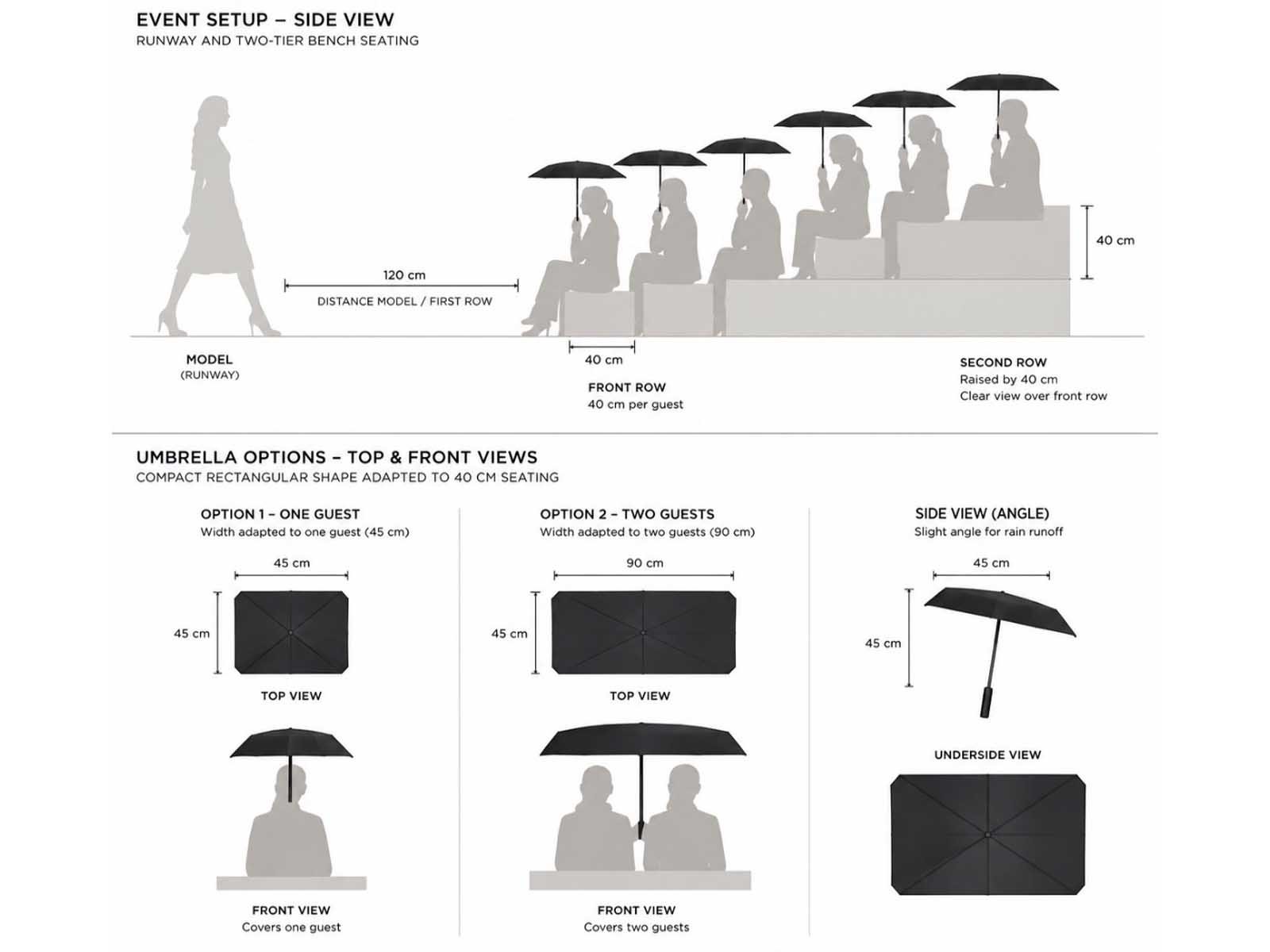
We once had a French project where the client did not want a standard round umbrella. They wanted to develop a special square rain-shade structure for an open-air performance, covering only one person.
It looked a little like a car windscreen sun shade, but the actual use was completely different.
This kind of requirement can no longer be fitted into an ordinary product catalogue. It has to be rebuilt from:
use case → required coverage → structure → sampling.
Handle
The handle is one of the easiest places to turn a private label product from “an ordinary umbrella” into “a branded product.”
Shape, material, colour, surface finish, logo, soft-touch feel and fully custom structures can all be discussed.
Tips and caps
Many brands focus only on the canopy and the handle, and overlook the tip and cap.
But these small parts are actually well suited to brand recognition, because they are not the decoration a customer would copy at first glance — yet they make the whole product feel more complete.
3D-printed parts
Depending on the project, we can evaluate using PLA, ABS, TPU, nylon, resin and other materials for prototypes or special parts.
For a simple structure, a 3D prototype usually takes about 3–5 days from design confirmation.
For complex curved surfaces, character shapes or models built from scratch, the modelling alone can take longer; the experience value for complex models is 15–20 working days, and these projects should be assessed separately at formal quotation.
The most valuable thing about 3D printing is not that it “looks high-tech.”
It is:
you can prove the design can really be gripped, fitted and opened — before deciding whether it is worth making a mould.
From Concept to Pre-Production Sample: What Really Decides Launch Timing Is Rounds of Changes
Our current common reference times:
| Stage | Reference time |
|---|---|
| Simple 3D-printed prototype | 3–5 days from design confirmation |
| Complex 3D modelling | Assessed by complexity; some projects up to 15–20 working days |
| Pre-production sample | 7–10 days |
| Bulk production | 15–25 days |
| Express | 3–7 days |
| Air freight | 7–12 days |
| Sea freight | 25–35 days |
But what brands most easily misjudge is:
development time is not these numbers added together mechanically.
The truly hard thing to predict is how many rounds the sample needs.
The first sample may reveal that the handle grip is wrong, the button position is uncomfortable, the Pantone looks too dark on the actual canopy, the logo looks larger than the render, the gift box makes the volume too high, or the product weight exceeds expectations.
So having changes on the first development does not mean the project failed.
On the contrary, the purpose of a sample is to expose these problems before bulk production.
If the launch date is fixed, the sample is the last stage I would compress.
You can discuss doing one fewer colour, switching to a proven frame, air-freighting the first batch, or simplifying the packaging — but skipping the physical sample means leaving all the risk to bulk production.
Brand Colour: Pantone Is the Starting Point, Not the Finish
What a private label product fears most is not “the colour is not nice.”
It is:
it does not look like your own brand colour.
A brand colour goes through many conversions from a design file to an umbrella: Pantone → dyeing or printing → different materials → physical light → the second reorder.
So I suggest doing at least three things.
1. Use Pantone, not colour names
Do not just write sage green, navy, burgundy.
If the brand already has a Pantone, give the number.
2. Look at the physical pre-production sample
A colour on screen cannot fully replace the physical object.
Especially when canopy, frame, handle and packaging all need to coordinate, it is best to look at them together.
3. Keep the standard on file
After approval, the factory keeps a reference sample, the Pantone follows the project on file, and the specification records the version.
That way, reordering two seasons later does not mean guessing the colour again.
For logo and canopy printing processes, see our umbrella printing methods comparison.
Retail-Ready Means the Warehouse Can Receive and Shelve It
If your umbrella is ultimately a product rather than an event giveaway, it is not truly finished until the packaging and labels are confirmed.
Hang tags and brand labels
These can include the brand story, materials, usage instructions, SKU, care information and the information required by the selling market.
Barcodes
If the product enters retail channels, EAN / UPC and other barcodes should be prepared to the channel’s requirements.
Do not wait until the goods are already in the warehouse and then have staff re-label piece by piece.
Retail packaging
Depending on the product positioning, you can choose a simple bag, custom sleeve, paper sleeve, gift box, retail hang card or ecommerce shipping packaging.
The goal of packaging is not “the more expensive the better.”
It is:
let the product reach your sales channel without needing a second round of processing.
If you want to understand export packing, logistics, carton marks and the import process, read our guide to importing custom umbrellas from China.
How to Set MOQ and Colours for the First Collection
Our current minimum for canopy customization is:
200 pieces per colour, per design.
Outdoor umbrellas usually start from 100 pieces.
For a brand building its first umbrella line, this MOQ supports a fairly realistic test.
For example:
4 colourways × 200 pieces = 800 pieces.
But that does not mean “four colours are always better than two.”
What is more worth considering for a first order is:
- which colours best fit your existing customers;
- which colours are easy to unify with the packaging;
- whether they can share the same frame and parts;
- which colour is worth leaving for the second batch.
If different colours each change the frame, handle, packaging and printing process, you are no longer developing several colours within one collection — you are developing several different products.
For a first batch, sharing the structure and changing colour and brand expression is usually easier to control.
Consistency Between Sample and Bulk Is the Real Quality Question
What a brand should care about is not only:
“Is the sample good?”
It should be:
“Will the bulk match this sample?”
So after the pre-production sample is approved, turn it into the production standard.
Our current published quality process includes:
- incoming material inspection;
- in-process inspection;
- finished product inspection;
- packaging inspection;
- final pre-shipment inspection.
Finished and final inspection can be carried out to AQL 2.5 / 4.0.
If a brand, retailer or investor requires it, SGS, BV, TUV or other third parties can be arranged for pre-shipment inspection according to the project.
Our currently published warranty against manufacturing defects is 1 year, handled per project as replacement or credit against a later order.
Exclusivity, Artwork and IP: Agree Before Development, Not After the Sample
If a design is truly a core product of your brand, exclusivity and file ownership must be written down early.
At least the following questions need to be made clear.
Who owns your design files?
Your logo, tech pack, 3D files, packaging artwork, drawings and private label visuals should be clearly used as your project materials, not for other clients.
What does “exclusive” actually cover?
Exclusivity is not one sentence:
“Please don’t sell this to others.”
A workable clause should specify:
- which part;
- which complete design;
- which markets;
- which customer types;
- for how long.
For example, restricting only one special handle is a completely different scope from restricting the whole umbrella.
Third-party IP must be resolved before production
If the design includes film or TV characters, artwork, co-branded brands or third-party logos, the brand should confirm it holds the right to use them before bulk production.
The manufacturer can produce to the files you provide, but cannot judge on the brand’s behalf whether a third-party IP licence is valid.
What a Real Private Label Umbrella Brief Should Contain
If you are preparing to start a private label umbrella project, you can turn the following 10 items directly into a brief:
- chosen route: print on existing model / OEM / ODM;
- product reference, mood board or tech pack;
- target customer;
- target retail price or cost band;
- first-order quantity and colour split;
- target launch date;
- Pantone and brand guidelines;
- structures and parts to customize;
- packaging, hang tag, barcode and channel requirements;
- sample approval, exclusivity and file ownership requirements.
You do not have to have all ten answered the first time.
But they move the discussion to real product development far faster than:
“Can you make umbrellas for our brand?”
Frequently Asked Questions
What is the difference between private label, OEM and ODM?
Private label can start from an existing product with brand elements added. OEM emphasises producing to the specification the buyer confirms. If the handle, tip, frame or another structure itself needs to be developed together, it moves into deeper ODM product development.
Can we start without a complete tech pack?
Yes. A reference product, photos, a mood board, target customer, target price and quantity are enough to start the first discussion. The specification is then gradually turned into a complete document as the project advances.
What is the MOQ for a private label umbrella?
Our current minimum for most canopy customization projects is 200 pieces per colour, per design. Outdoor umbrellas usually start from 100 pieces. When special moulding and structural development are involved, the practical MOQ is re-assessed by part and process.
Can you customize the handle, tip and frame?
It can be assessed per project. Handles, tips, caps, frame sizes and other special parts can all enter the development scope. Some complex custom-shaped parts can first be validated through 3D printing.
Is 3D printing only for samples?
Not necessarily. 3D printing is very well suited to prototypes and low-volume special parts. Once volume grows, you can compare whether continuing 3D printing or moving to moulding for mass production is the better cost structure.
How long does it take from concept to sample?
A simple 3D prototype usually takes about 3–5 days from design confirmation. Complex modelling projects take longer. A pre-production sample usually takes about 7–10 days. The real development cycle also depends on the number of sample revision rounds.
Can you do hang tags, barcodes and retail packaging?
Yes. The project can include sleeves, hang tags, barcode labels, single-unit packaging, gift boxes and carton marks, plus other retail-readiness items.
Can we test a small collection first?
Yes. The usual MOQ of 200 pieces per colour per design lets a brand validate the market with fewer colours and a smaller collection first, then reorder and expand colours based on sales.
How do you keep the second batch consistent with the first?
Keep the approved pre-production sample, Pantone, final specification, packaging files and version numbers. Reorders are matched to these records rather than judged again from images.
Can you make an exclusive product?
It can be discussed. But exclusivity needs to be specified to the exact part, complete design, market and time range, and written into the project file or contract — not left to verbal understanding alone.
Developing a Private Label Umbrella Line?
If you already have a concept, you do not need to finish designing every part first.
Just send us:
Reference / Mood Board + Target Customer + Target Retail Price + First Order Quantity + Brand Direction + Launch Date
We can first judge whether the project should start from an existing structure, move into OEM, or needs deeper ODM and special-part development.
Then we move into the sampling and production plan.