When a company orders a batch of branded umbrellas, the thing that actually keeps a procurement manager up at night is rarely “this umbrella costs a few cents more.”
The more realistic questions are:
- will all 1,000 pieces arrive on time, in full;
- will the brand blue match the company’s visual guidelines;
- will the three offices each receive the correct quantity;
- were the gift box, hang tag and carton marks done to spec;
- can finance clear the paperwork without friction;
- and next year’s reorder — will it suddenly come back in a different blue, with a different handle.
That is why I always say a corporate custom umbrella is first a procurement project, and only then a rain product.
If you are buying a batch of logo umbrellas for employee gifts, client gifting, an anniversary, a conference, a golf event or a brand project, this article is not about telling you “which umbrella is best.” It is about helping you plan corporate umbrellas bulk orders properly — getting the specification, budget, sampling, packaging and delivery structure straight first, and counting backwards from the date that actually matters.
Start With the Conclusion: Which Umbrella Fits Each Corporate Gifting Scenario?
The easiest way to waste time in corporate purchasing is to open a catalogue of dozens of models and start browsing slowly.
A faster approach is to look first at the recipient and the use case.
| Corporate project | Umbrella type to consider first | What matters most when buying |
|---|---|---|
| Employee commuter gifts | Folding umbrella | Portability, weight, auto open, sleeve |
| Annual gala / anniversary gifts | Folding / straight umbrella | Brand colour, packaging, event date |
| VIP client gifting | Golf / premium straight umbrella | Handle, feel, gift box, brand detail |
| Golf tournament / sponsor gift | Golf umbrella | Size, wind structure, logo area |
| Multi-office employee benefits | Folding umbrella | SKU, carton split, address split |
| Creative brand gifting | Special custom models | 3D handle, ferrule, packaging, lead time |
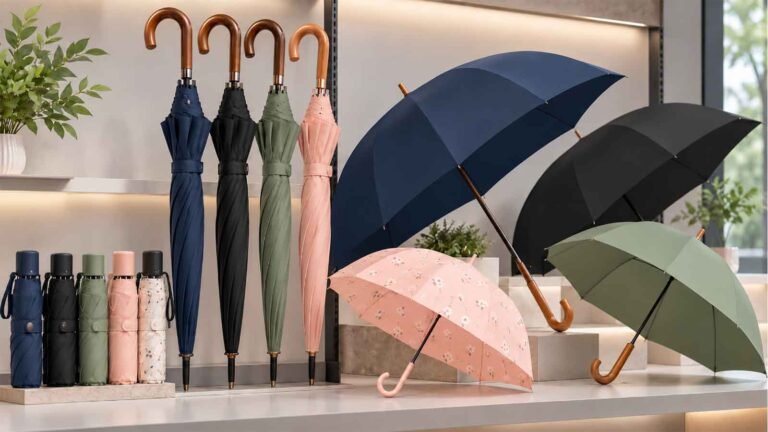
For employee commuter use and high-volume everyday gifting, start with our custom folding umbrellas.
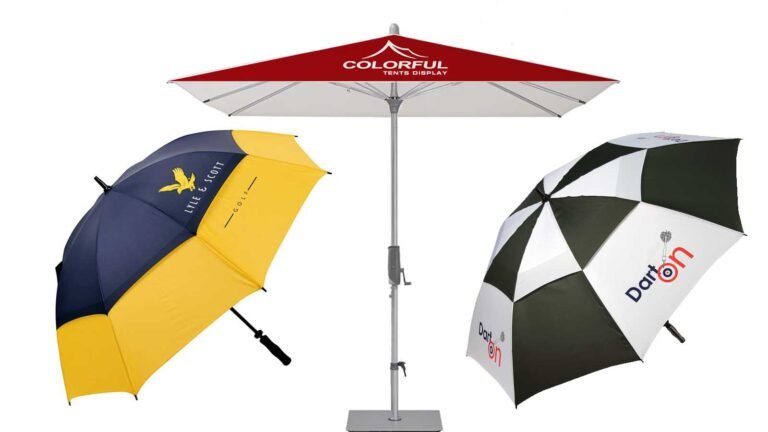
For corporate golf days, sponsorship or premium client gifts, look at our custom golf umbrellas.
If the project wants to carry the brand onto the handle or other components, also see our guide to custom umbrella handle development.
Lock These Six Things Before You Request a Corporate Umbrellas Bulk Quote
Many corporate enquiries start with a single sentence:
“We need 1,000 umbrellas with our logo — how much?”
That is actually very hard to turn into an order-ready price.
Because the final cost of a corporate custom umbrella is not decided by quantity alone. The six items below usually matter more than the “1,000 pieces” number itself.
1. Umbrella type and size
Our common size ranges include:
- Golf umbrellas: 27–34 inches (68–86 cm)
- Straight umbrellas: 23–30 inches (58–76 cm)
- Folding umbrellas: 19–23 inches (48–58 cm)
- Kids’ umbrellas: 17–21 inches (43–53 cm)
A folding umbrella that fits into an employee’s laptop bag and a 30-inch golf umbrella handed to clients at a corporate tournament are two completely different purchasing projects.
So the first question is not “which one is most expensive?” but:
In what scenario will the recipient actually use it?
2. Brand colour
If your company has a formal brand guideline, the best input is a Pantone reference.
Do not just write:
- company blue
- dark navy
- corporate red
To a person’s eye, each of those could mean many different things.
3. Logo position, size and colour count
The logo can be placed on:
- the canopy;
- multiple canopy panels;
- the valance;
- the sleeve;
- the tie;
- the packaging;
- the hang tag.
But “one logo” and “the same logo repeated on four panels” are not the same quote.
If you are not sure whether to use screen printing, heat transfer or another process, just send the artwork to the factory. We have a separate umbrella logo printing methods comparison, so this article does not repeat every process detail.
4. Packaging
At minimum, confirm ahead of time:
- standard export packing;
- individual OPP bag;
- custom sleeve;
- hang tag;
- gift box;
- custom retail packaging.
Packaging is not something you “add on at the end.”
For a premium client project, packaging can influence the recipient’s first impression even more than printing one extra logo on the canopy.
5. Delivery structure
One address, or three, ten or more office locations?
Do they all need to ship together, or in batches?
Should the cartons be marked separately per destination?
If this is not made clear at the quoting stage, what gets added later is usually not just freight — it is re-boxing and re-labelling work.
6. Required in-hands date
What really matters in a corporate project is:
when the goods must be in hand.
Not “we will probably order around November,” but:
“The staff gala is 8 December, and all three offices must receive everything by 3 December.”
That date directly decides whether sea freight works, whether air freight is needed, whether complex packaging is worth it, and how much time is left for sample changes.
Quantity, Budget and Timeline: The Three Numbers Behind Your Internal Approval
Buyers often have to talk to suppliers and also apply for budget internally.
If all you bring back is:
“We want to order a batch of nicer umbrellas.”
the approver will keep asking questions.
But if you bring back:
- 1,000 pieces;
- a budget breakdown;
- delivery by 3 December;
the internal discussion becomes much simpler.
Quantity: work backwards from the number of recipients, then check the MOQ
Our standard MOQ is usually:
200 pieces per colour, per design.
Outdoor umbrellas usually start from 100 pieces.
If a company has 900 employees, for example, do not order exactly 900 pieces.
A real project usually also hits:
- new employees joining;
- one office needing a few extra pieces;
- individual pieces needing replacement;
- marketing adding to the client list at the last minute.
So quantity is best worked out from the actual number of recipients, plus a sensible buffer.
If 1,000 pieces need to be done in two brand colours, for example:
- 600 navy;
- 400 white;
both colours reach the MOQ, and the project is comfortable.
But a single-colour project of just 150 pieces is already below the usual 200-piece minimum and needs to be discussed separately.
For more on MOQ, samples and production times, see our custom umbrella FAQ.
Budget: do not guess one total — split it into lines
A corporate purchasing budget is best split into at least:
- unit price;
- logo / printing cost;
- samples;
- packaging;
- freight;
- duty and clearance where applicable.
Ordinary custom samples are currently around USD 30–80 per piece, depending on complexity, plus freight.
3D creative-part samples start from USD 50, charged by design.
For bulk orders above 1,000 pieces, the ordinary sample fee can usually be refunded within the order; projects involving complex 3D creative parts are confirmed separately.
Separating these costs makes everything easier to read for both purchasing and finance.
Timeline: do not add forward from today — subtract backwards from the event date
This is the habit most worth building in a corporate project.
The gala date will not move just because the factory is three days late, and the golf tournament will not wait for your umbrellas.
So the purchasing timeline should be counted backwards from “the date the goods must be in hand.”
Where Branded Gifts Most Often Go Wrong: Colour Is Not “Close Enough”
Brand colour is the specification most easily written vaguely — and the one most likely to draw complaints — in corporate gifting.
For an ordinary stock umbrella, two dark blues may look roughly the same.
But when the umbrella sits next to your:
- exhibition stand;
- staff uniform;
- gift box;
- brand book;
- event backdrop;
“just a tiny bit off” can become obvious at a glance.
Pantone is the communication standard, but the physical sample is the final word
Write the Pantone reference of every key brand colour into the order.
Then, at the pre-production sample stage, confirm at least:
- canopy colour;
- logo colour;
- logo position;
- logo size;
- packaging colour.
After the physical sample is approved, ideally:
- the buyer keeps one;
- the factory keeps one;
- the sample or record notes the order and date.
That way, next year’s reorder is checked against the same standard, not against a possibly compressed photo in a WhatsApp chat.
Packaging Decides Whether the Umbrella Feels Like a Gift or a Giveaway
This is a point I think many buying guides treat too lightly.
How the umbrella is presented really does change how the recipient sees it.
The same umbrella:
pulled out of an ordinary clear bag looks like a utility item.
Placed in a designed gift box, with a company thank-you card, and with the logo and packaging colour unified, it reads far more like a proper gift.
So corporate projects should choose packaging by how the umbrella will be used.
Standard export packing
Lowest cost, suited to:
- receiving into a company warehouse;
- re-packing internally afterwards;
- high-volume benefits distribution.
Individual OPP bag
Simple and neat, suited to large employee projects and direct on-site handouts.
Custom packaging or gift box
Better for:
- VIP clients;
- anniversaries;
- employee recognition;
- executive gifts;
- brand events.
Custom hang tag
Besides the logo, a hang tag can carry:
- the project name;
- the event date;
- a thank-you line;
- product notes;
- specific batch information.
Packaging is best quoted as its own line, not assumed to be “already included.”
Multi-Office and Split Delivery: Treat Addresses as Part of the Specification
Many corporate projects are not “1,000 umbrellas to one warehouse.”
The reality may be:
- New York office: 300 pieces;
- Los Angeles office: 200 pieces;
- London office: 300 pieces;
- event site: another 200 pieces.
At that point “delivery address” is no longer just logistics information — it becomes part of the product and packaging specification.
How many cartons does each destination need?
Should the cartons be marked separately with:
- Office A;
- Office B;
- Event;
- SKU;
- quantity;
all of which should be decided in advance.
Otherwise one head office receives everything and staff have to re-open, count and re-distribute — which is also a cost.
A real project that made me take split shipping seriously
We had a UK project where the client’s first batch of umbrellas had to hit a fixed film-release date.
That kind of date is not “a few days late is fine.”
If the first batch missed it, the marketing value was gone.
So in the end the order was not shipped by a single method — it was split:
the most urgent part went by a faster method first, and the rest was topped up later by a lower-cost method.
That is why I suggest corporate clients tell us directly when they enquire:
which quantities are the most urgent, and which can wait.
Very often the shipping plan is not “sea or air, pick one” — it can be a combination.

Lead Times: When the Event Date Is Fixed, Always Leave Room for Chinese New Year
Our common timings can serve as a project-planning reference:
| Stage | Reference time |
|---|---|
| 3D-printed prototype (special-shaped parts only) | 3–5 days from design confirmation |
| Pre-production sample | 7–10 days |
| Bulk production | 15–25 days, depending on quantity and complexity |
| Express DHL / UPS / FedEx | 3–7 days |
| Air freight | 7–12 days |
| Sea freight | 25–35 days |
Specific orders are still re-confirmed according to quantity, complexity and the production schedule at the time.
Why a March event is not simply “order in February”
If your gala, anniversary or large event falls around February–March, remember Chinese New Year when buying from China.
During Chinese New Year, many Chinese manufacturers and their upstream suppliers take a break, and some staff travel back to their home provinces.
What is really affected is not just “the factory stops for a few days.”
Before and after, it may also involve:
- raw material supply;
- packaging factories;
- the printing step;
- domestic logistics;
- international freight space;
- the speed of restarting after the holiday.
So if a project must arrive in early March and you want sea freight, I would rather suggest confirming the purchase by December of the previous year — or even earlier — than leaving everything pinned on February.
Not because every order needs that long, but because a corporate event usually has no second chance.

What Procurement Managers Actually Ask: Quality, Inspection and Documentation
During vendor onboarding, a purchasing team usually does not just ask:
“Is the quality good?”
They more likely need an answer that can be written into an internal record.
Our current quality process includes:
- incoming material inspection;
- in-process inspection;
- finished product inspection;
- packaging inspection;
- final pre-shipment inspection.
Finished and final inspection can be carried out to AQL 2.5 / 4.0.
AQL is a sampling acceptance system; the current ISO 2859-1:2026 is the international standard that organises lot sampling plans by Acceptance Quality Limit.
If a corporate project has a higher order value, we can also arrange SGS, BV or TUV third-party inspection before shipment, according to the order.
Compliance: Do Not “Check Every Standard” — First Look at Where You Sell and Who You Give It To
Corporate purchasing often comes with a vendor qualification form listing many standards.
The most common mistake here is thinking that more standards written down equals more professionalism.
The more professional approach is:
first confirm the destination market and product use, then confirm which requirements actually apply.
For example:
EU ordinary adult corporate gifts
For chemicals and materials, the first thing to watch is usually the applicable EU regulation such as REACH.
US children’s products
If the product is designed or mainly positioned for children aged 12 or under, the US CPSC has a specific definition of a “children’s product,” which may involve testing, certification and tracking requirements under CPSIA.
So a kids’ umbrella and an ordinary adult employee gift umbrella cannot use the same compliance logic.
EN71
EN71 belongs to the EU toy safety standard system.
Whether it applies depends on whether the product falls within the relevant toy regulation scope — not because “children may use it” automatically means every EN71 item must be tested.
RoHS
RoHS mainly restricts hazardous substances in electrical and electronic equipment.
An ordinary mechanical umbrella should not mechanically be written as “RoHS required” just because it is exported to the EU; if the product adds electronic lighting or similar functions, evaluate it against the actual structure.
If your corporate project has a designated supplier compliance list, it is best to send the destination market and requirements directly, then confirm the corresponding materials, tests and documents per order.
Vendor Onboarding and Finance: It Is Really About Whether the Documents Match
Many orders do not get stuck on the product — they get stuck on finance and purchasing systems.
At the start of a project, the corporate buyer is best off telling the supplier in advance:
- whether a Purchase Order / PO is required;
- the invoice title;
- the receiving company;
- billing address;
- shipping address;
- vendor code;
- whether a specific packing list format is needed;
- whether a certificate of origin is needed;
- whether third-party inspection is required.
The export and transaction documents a supplier usually prepares include:
- proforma invoice;
- commercial invoice;
- packing list;
- bill of lading or transport documents;
- certificate of origin where applicable.
Our published payment terms include:
T/T 30% deposit + 70% before shipment.
PayPal or Western Union for samples and small orders.
L/C can be discussed per project for orders above USD 10,000.
Alibaba Trade Assurance can also be discussed if the buyer’s process requires it.
For a Three-Year Gifting Programme, the Most Valuable Thing Is Not a Lower First Price
If a project repeats every year, what is really valuable is:
not having to start from zero again next year.
For a long-term project, keep these three things on file:
1. Pantone references
The corporate brand colours follow the project record.
2. Approved samples
Have the factory keep a reference sample to check reorders against.
3. Versioned specification files
For example:
- V1: first-year version;
- V2: second year changes the sleeve to a zip pouch;
- V3: adds one more logo.
Then even if the purchasing person changes within the team, you avoid:
“I think that’s how it was last year.”
The 200-piece-per-colour-per-design MOQ also lets some corporate umbrellas bulk projects top up by department, region or event batch, instead of re-doing a very large quantity each time.
Pre-Order Checklist for Corporate Umbrellas
Before actually releasing an order, check these ten items once more:
- number of recipients and spare quantity;
- umbrella type and size;
- corporate brand Pantone references;
- logo position, size and colour count;
- packaging, hang tag or gift box requirements;
- each receiving location and its quantity;
- required in-hands date;
- whether the pre-production sample is approved and kept on file;
- inspection requirements, whether third-party inspection is needed;
- payment, documentation and vendor onboarding requirements.
If these ten are written down clearly, the production communication that follows becomes much lighter.
Frequently Asked Questions
What is the MOQ for corporate custom umbrellas?
The standard MOQ for most umbrellas is 200 pieces per colour, per design; outdoor umbrellas usually start from 100 pieces. Smaller trial orders can be discussed per project.
How much do 1,000 corporate logo umbrellas cost?
An accurate price cannot be given from quantity alone. It also depends on the umbrella type, size, fabric, frame, print position, logo process, packaging and destination. Providing all of these together gets you an actionable quote far faster than asking “how much for 1,000 pieces” on its own.
For employee gifts, is a folding or golf umbrella better?
If employees carry it on a daily commute, a folding umbrella is usually more convenient. For premium client gifts, golf events or a larger logo area, a golf umbrella is worth considering.
Can you match our corporate Pantone colour?
Brand colour matching can be done according to the order. If the brand colour is strict, confirm both the Pantone reference and a physical pre-production sample.
Can you provide gift boxes, hang tags and custom sleeves?
Yes. Standard export packing, individual bags, custom packaging, hang tags, gift boxes and sleeves can all be confirmed per project.
Can you deliver to multiple offices?
Yes. It is best to provide the quantity for each address at the quoting stage, so carton splitting, marking and different shipping plans can be arranged in advance.
How long does a corporate custom umbrella order take?
Our current general reference is: pre-production sample 7–10 days; bulk production 15–25 days depending on quantity and complexity; express 3–7 days; air freight 7–12 days; sea freight 25–35 days. Extra time should be reserved for Chinese New Year, peak season, complex packaging and special development projects.
Can you arrange third-party inspection?
Yes. SGS, BV, TUV or other third parties can be arranged for pre-shipment inspection according to the project.
Can you provide the documents our vendor onboarding needs?
Common documents include proforma invoice, commercial invoice, packing list, transport documents and, where applicable, certificate of origin. If your internal process has other vendor onboarding documents, send the list at the start of the project.
How do reorders stay consistent with the first batch?
Keep: the Pantone references; the approved artwork; the confirmed sample; and the final specification file with its version number. Reconfirm against these records on reorder, rather than relying only on photos or chat history.
Preparing Employee Gifts or a Client Gifting Programme?
If you already have a corporate purchasing project, you do not need to study every umbrella specification first.
Just send us:
Quantity + Recipient / Use Case + Logo + Brand Colour + Packaging Requirement + Destination + Required In-hands Date
If the umbrella type is not decided yet, we can help narrow the choices from the recipient, budget, event scenario and deadline.